Taikapuikot
By: Merja Palin
Publisher: Etana editions, Finland, 2020
Format: Hardback


Magic needles
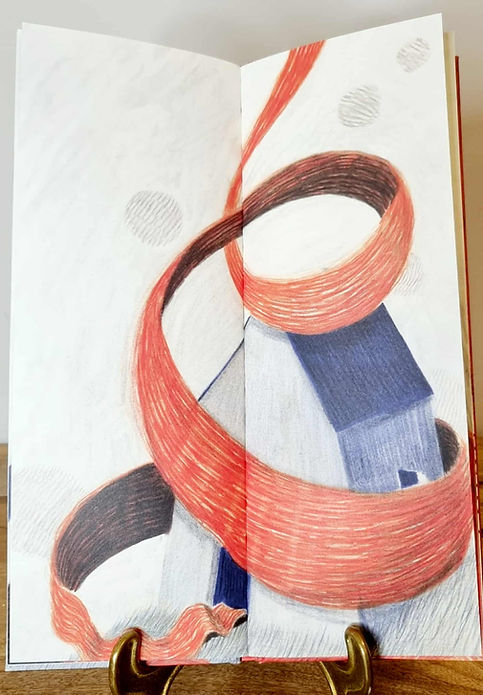
Taikapuikot means "magic needles" in Finnish. The author offers a nice, multilingual treat by translating the title to 13 different languages at the start of the book. The book´s shape reflects the title: It measures 12x32 cm, an unusually long and narrow format - like knitting needles!
The illustrations are drawn with colored pencils in a restricted palette: shades of blue, red and a little green at the end. The first two spreads are all blue. We see a naked winter landscape where the wind blow right through a house. On the next spread, we see a girl, standing in the wind, clearly freezing. Luckily, this girl has a mother who knits, and the first thing she produces is a pair of socks for her daughter. The wind touches the mothers hands, the knitting needles fly in the air, and suddenly there is a pair of mittens too. Both mother and daughter are still blue, but the mother keeps knitting, and knitting and knitting, until the girl is wrapped in wool and the whole house is surrounded by a cozy warm scarf. The mother and daughter are no longer blue, they are warm and cozy inside. But even if the mother has laid down the needles, we se the yarn moving outside, and the last two pages shows the enourmous scarf extends also to the two trees. The wind is still blowing, but the grass is green again. The back-cover is all red yarn.
The book reminded me of a traditinal Norwegian fairytale of a magic pot of porridge that was given to a poor girl and her mother. Long story short: The pot would not stop cooking, and the porridge flowed out of the house into the village. "Taikapuikot" can be read like that, like a fairytale of magical needles that will not stop knitting. But like with all great silentbooks, it has room for many other stories. At the start of the book, there is a distance between the girl and her mother. Not only a physical distance, but also a lack of eye contact or communication. Either the girl has her back to her mother, or the mother has her back to the girl. When the girl gets all dressed up in warm, red wool, her eyes can be read as more scared or confused than happy. She leaves the house to go outside. The next spread shows the mother knitting, with a twinkle in her eye, followed by a spread where the girl is drawn to the house by the long scarf she is creating. Finally, the girl ends up at the mother´s lap. The warmth overcame the cold. Taikapuikot can be read as a story of belonging, of love, of the difficult relationship between mothers and daughters - it is one of those silent books you can read and re-read and keep finding new depths to the story.
The long, narrow format is masterfully utilized. Each page is a small work of art, perfectly composed. The whirls of the wind is mirrored in the swirls of the yarn. There is great attention to details that adds to the story, like how the mother´s hair gradually goes from very neat to a complete mess when she is in her knitting frenzy, only to be perfectly neat again when warmth and connection is restored.
Taikapuikot was Merja Palin´s debut book. It was selected for the Finnish Book Art Association's Most Beautiful Books list in 2020.