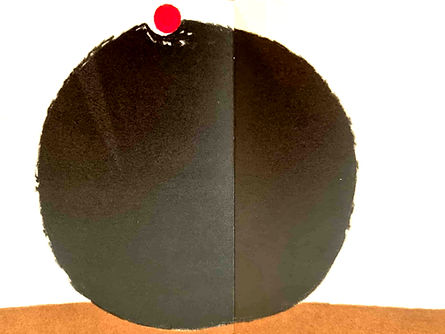
Le petit chaperon rouge
By: Warja Lavater
Publisher: Adrian Maeght, France, no year listed (Original edition Adrien Maeght 1965)
Format: Leporello (original edition in plexiglass cover)


A traditional fairytale in a whole new language
Warja Lavater was a Swiss artist and illustrator specializing in the artist´s book genre. She did amazing work, always working with the principle of telling stories using abstract symbols. Her five "Imagineries" are considered her masterpieces. They are rooted in traditional fairy tales and were published between 1965 and 1982. Lavater explored the rethinking of a text through images and vice versa. Her goal was not to render a tale as it was written, but to use it as a base for illustrations that give room for each readers imagination and storytelling.
Lavater was inspired by street signs and other visual codes and clues, which is quite obvious when you see the "instructions" to this book. The opening pages feature an overview of all the characters, together with an explanation in seven different languages. For example, the red dot is little red riding hood, the black is teh wolf, the green dots the forest and so on. The reader can navigage through the book, that reads like a map over the story.
The Imagineries are all leporellos, Lavater got the inspiration from calligraphers in Chinatown that used accordion-like formats. This works really well, because you can stretch the whole thing out and see the explanation and the illustration at the same time. It also gives the feeling off being part of a long quest. I find the visual codes really fascinating, especially when she breaks the "recipe", like when the wolf devours Little Red Riding Hood and it shows like a fire in his belly.
"Le petit chaperon rouge" requires some knowledge of the original story. But that does not stop children from making up their own stories as their go along. In my experience, most adults approach this book differently, deciphering it like it is a code - "oh, look, here the wolf eats Little Red Riding Hood", "Look, here is the house!" It brings out both attention to visual clues and to storytelling and intratextual references. Lavater wanted this, she wished for the reader to become a narrator, renewing the story by adding his or hers experiences and feelings.
(Source: Colistra, D. (2022). Performative Readings. Warja Lavater’s Wordless Tales. img journal, (7), 100-125.)

Reading Lavater´s work is an aestethic experience. If you want to train our ability to read pictures and visual clues, this book is also perfect for that. It is a very original work of art, well worth the price. These books were out of print for a long time, and the prices for the original ones are quite steep. Luckily, Editions Maeght has reprinted some of the stories, true to the original look, feel and format (the only difference being that the latest editions do not have the plexiglass case of the original).