
The Autrement Jeunesses-collection:
A unique piece of silent book history!

In 2004 the French editor Autrement Jeunesse started a groundbreaking project: They invited illustrators to make wordless picturebooks, today known as silent books. The group of illustrators was quite diverse: Some in the beginning of their careers, others well-established, all with very different illustration styles.
The result was absolutely amazing: A total of 27 silent book titles that was published in the series Histoire sans paroles between 2004 and 2014.
Because a lot of them are now out of print, this collection is in danger of being forgotten, so Readsilentbooks made it our mission to collect every single book in the series - and we are delighted to announce that our Autrement Jeunesse Histoire sans parole-collection is now complete!
In this article, you get to learn more about the series and explore each title. There are some real picture book treasures in here, so you're in for a treat!
Book format and layout

The "stories without words" series was groundbreaking in more ways than one. It was the first series of silent book published with all books in the exact same format, but written by different authors. The multitude of illustration styles and themes promote imagination, joy of reading, visual literacy and aesthetic knowledge.
The choice of a set format for every book has been important. It is very interesting to see how 20 different illustrators approach telling a wordless story in this exact format - in a total of 27 titles. Each book comes with a cardboard "box", so that when you take the book out of the box, there is no title on the front page. This is the same technique that Enzo and Iela Mari used making their iconic silent books back in the 1960s. Very few publishers have tried to copy it, probably due to the extra printing expenses of the box.
Unfortunately, only a few titles in our collection still have their cardboard boxes. The majority of our books are bought second-hand, so our guess is that most are probably just lost or destroyed. Some of our copies are also discarded library books, others reprints from other countries that might never have included the box.
Even with the box, the books are not completely wordless, they still have a title page and the peritext printed inside. but the wordless covers are a really nice touch! Most of the boxes have the same cover picture as the book itself. But a few, like "Coup de fourdre au zoo" pictured above, uses the possibility to add an extra surprise for the reader - the situation is reversed from the box to the cover.


The books all measure 29x16 cm. It is a perfect format for children's hands, even the youngest readers can easily hold and operate the book by themselves. When opened, the long horizon offered by this format is excellent for stories about being on some kind of journey, of movement, and of picturing size.
In the 27 books in the series, the illustrators use the format differently: Some are striking full spreads, like the picture of the knight and the dragon from Le chemin. Other storytelling techinques are two pages per spread, like the picture in the middle from La course au renard, and others also uses panels, like Chagrin d'ours story of a very angry bear.
Presentation
of all the books in the collection:
Now to the best part: A presentation of all the books! Because quite a few authors have written two or more books in this series, we have chosen to list the books alphabetically instead of cronologically, after the author's last names.
Find a book you love? Even though many of them are out of print, most are still possible to find at online antiquarians, and a few are still for sale in ordinary bookstores. Enjoy!
Geraldine Alibeu
La course au renard

A family is sleeping peacefully in their tents when a small fox wanders by. The sled dogs catches his scent and runs off to get him, capturing a young boy as they do so. A fast-paced and caothic chase ensues.
Using a restricted, but striking color palette, Alibeau creates a beautiful, somewhat surrealistic Artic environment. Her use of blue makes the reader feel the cold in this vast landscape in the North.
Geraldine Alibeau is an illustrator, animator and performer that has written and illustrated several picturebooks. La course au renard (The fox chase) was one of the first books in the series, published in 2004. It was republished by Cambourakis and is still in print.

Ronan Badel
Le rêve du pêcheur & L'ami paresseux

Ronan Badel is a very productive illustrator that has published over 150 titles, so it is no big surprise that he contributed two book to the Autrement Jeunesse Histories sans Paroles-series. They are stand-alone titles, but Badel's sense of humor and eye for original ideas is obvious in both books.
Le rêve du pecheur (A fisherman's dream) was published in 2006. A fisherman is daydreaming in a bar. In the dream, he is king of the ocean, facing the dangers of the sea and an enormous fish together with his little dog, who ends up saving both him and the boat.
The story is told in watercolor illustrations, alternating between using the white of the page as the frame and full bleeds. This mode of storytelling leaves the reader with many questions: Whose daydream is this - the dog's, the fisherman's or both? Or is maybe what happens at sea the reality and what happens at the bar the dream?
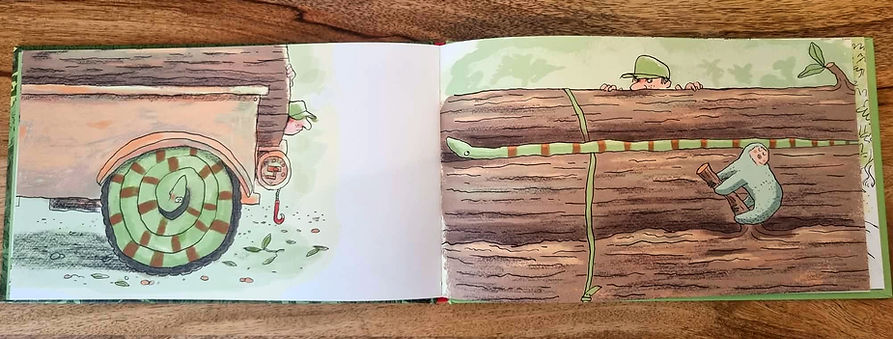
Badel uses the same technique for L'ami paresseux (The lazy friend) published in 2014 - watercolor illustrations with thin, black outlines. This story takes place in a jungle, where an unlikely group of friends: A snake, a sloth, a parrot and a frog, enjoy life together. When danger, in form of humans, threaten them all, the snake risks everything to save his lazy friend.
A humorous story of friendship (and unbelivable sleeping skills) with a heartwarming ending.

Barroux
La fabrique

A worker does his job, alone in a huge factory. We see him transport, gather, assemble, screw, mix and paint different elements, then it becomes obvious what he does: He makes beautiful clouds that enchances the sky.
Clouds are a phenomenom that intrigues most children - and also many adults. When reading this book to children, most of them run to their drawing station afterwards, to dream up the clouds they would have made if they had a factory like this, instantly inspired by the artwork.
Each illustration is a gorgeous double-spread- perfect for showing the size of both the factory and the sky. Barroux is a recognized artist known for his elements of surprise and diverse use of techniques.

Juliette Binet
Edmond

When the book is by Juliette Binet, our expectations are sky-high! We were pleased to find that Edmond (2007) holds the same quality, beauty and originality as Binets other works.
Using a very limited color palette and a lot of white space, this little book is a powerful statement on identity, belonging and the need to fit in.
It is also the perfect example on how less can be more in visual storytelling. The old-fashioned masks are both beatiful and unsettling, a perfect choice. Edmond is book that will appeal to children and adults of all ages, because of its layers of depth and meaning.
Binet is a famous artist, known for her groundbreaking visual works and sculptures.

Vincent Borgeau
Le Petit Train

Le petit train (2012) translates to The small train. This is a fun and whimsical visual journey: A train with a conductor, an elephant, a dog and a child picks up a zebra at a station. From there, strange things start to happen....
Borgeau uses the long, narrow format of this series beautifully, it is perfect for a journey on long train tracks. Le petit train is like a visual game, urging the reader to read the pictures mindfully, with humorous confusion as a reward. A great book to build visual literacy in a very fun way!
Originally from Belgium, Vincent Borgeau now lives in France, where he has published more than fifty children's books.

Edith Cadot
Le songe

Le songe (2009) means The dream. Edith Cadot uses dark and bold colors to create a dreamlike atmosphere. A young Indigenous American lets his imagination take him on a journey through canyons, meadows and cactus deserts. He overcomes the depth of the oceans and the danger of giant beasts before returning safely back home, or back to reality...
Cadot uses the long, narrow format mostly for full-spread illustrations, with some spreads holding two illustrations to set a faster pace in dramatic sections. An original and visually stunning silent book that will appeal to a wide range of children.
Edith Cadot is an illustrator, animator, comics creator and color designer.

Aurore Callias
Coup de foudre au zoo

A boy visits the zoo with his family. He experiences a moment of intense eye contact with an orangutan. From there, a series of wild and unexpected things start to happen...
Coup de foudre au zoo (2014) tranlates to Love at first sight at the zoo, but Callias has not created a love story...For many adults, the book will feel unsetting, commenting of our treatments of animals and the likeness of our species. For many children, it will be an amusing and charming "put the world upside-down" story
A wonderful work by Aurore Callias, the creator and illustrator of a lot of French picturebooks.

Olivier Charpentier
Le Cerise
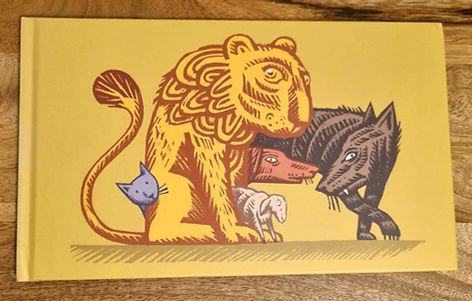
A perfect small, red cherry is placed on the bottom right corner of the page. A small, white mouse is heading for it. But then - a cat! The cat chases the mouse away, but meets a dog, the dog meets a wolf and so the story goes - until the funny and suprising ending.
The cherry remains untouched, which seems like a perfect comment to the world today - at some points, our fights turned into fight for fights sake, we forget what we were after in the first place...
Charpentier is an acknowledged visual artist. And it is his amazing artwork that makes Le Cerice (2006) so special: The animal's body languages and expressions are both beautiful and expressive, and the layouts are perfect.

Gaëtan Dorémus
Western & Chagrin d´ours

Gaëtan Dorémus is a highly productive artist and illustrator. He has contributed two titles to the series, Western (2013) and Chagrin d'ours (Bear's sorrow) in 2010. Although they are stand-alone titles, they are easily recognizable due to his distinct illustration style, originality and amazing sense of humour.
There are not that many silent book westerns, so this one is a treat! It has all the elements of a traditional western: A sheriff, a bandit, an escape from prison, a standoff...but also elements of surprise, like the loveliness of ladybugs* that have an important part in the action.
A wonderful story bursting with action and humor.
Chagrin d'ours is a very different story, but this too offers a lot of action and humor. A bear sleeps with his teddybear in the forest. Different animals try to either taunt him for having a teddybear, or to steal it, which proves to be a REALLY bad idea. A very dramatic adventure bound to be a favourite for all lovers of teddybears.
Both books are republished by Cambourakis and are still in print.
*Yes, a group of ladybugs is called a "loveliness" - isn't that the most wonderful thing?


Princesse CamCam/Camille Garoche
Mademoiselle Coton & Une rencontre

Camille Garoche's pen name was Princesse CamCam at the times these two books were published, Mademoiselle Coton in 2008 and Une rencontre (A meeting) in 2013. They are stand-alone titles made with different techniques.
In Mademoiselle Coton, the reader gets to join a tea-party, where the yong mademoiselle has made sweet treats for her group of animal friends. Everyone is happy until the hen spoils the girl's pristine white dress, which makes her really angry. She chases the animals through the forests, in a surreal landscape with an Alice-in-wonderland-vibe. During the chase, her dress is stained with lots of colors, and the chase results in a happy ending with a friendly food fight.
This is a striking and original visual story, with lots of small, beautiful details to explore, and a wide range of emotions on display.
Une rencontre, that was published five years later, is made using Garoche's now well-known, gorgeous papercuts. We have already made a full review of this book, you can read it here.


Arthur Geisert
Eau glacée & Le grosse graine

Arthur Geisert is one of the few authors in the series that are not French - he is from the US. His pigs are well-known for all lovers of children's books, in Geisert's amazing worlds there are no limits to what these antromorphic createurs can do. Even though the two books are stand-alone titles, his use the pigs as procrastinators make them feel like a duology.
In Eau glacée (Ice water), published in 2009, the pigs suffer under the burning sun. With an amazing vessel - a flying balloon-ship, they travel to an iceberg and sails the whole thing back home, finally getting relief from the heat.
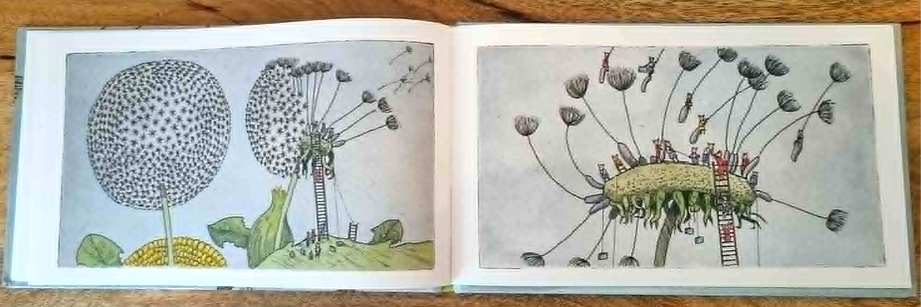
In Le grosse graine (The big seed), published the year after, a giant seed lands in a pig village. Luckily, they decide to plant it, because when the seed has turned into a giant dandelion, a vulcano erupts, completely destroying their homes. The pigs use the dandelion seeds to fly to a new home.
Geisert has a very intricate and interesting illustration style. In both books he uses a technique where the reader watches the pigs as if through binoculars in one or two illustrations, like an invitation to take closer part of the action. The way the pigs work together in a crisis and find inventive answers to natural disasters is not only very entertaining, it is also an imortant reminder and lesson for all of us.

Bruno Gibert
Petit poisson voit du pays

Petit poisson voit du pays (2004) was one of the first book in the series. The title translates to Little fish sees the world. An unexpected friendship with the house cat makes the little fish able to take a vacation from small goldfish bowl and tour the world.
We follow her through the sewers, into pools, lakes and rivers, to the depths of the ocean and the clouds of the sky until she eventually returns to tell her cat friends of her adventures.
Gibert's clever use of panels guides the reader through the journey. The pattern of the canvas is visible in the illustrations, which creates a very interesting effect when placed on the white page.
Gibert is known as an inventive author and illustrator who has published more than 20 works.

Raphaël Hadid
L'etoile tombée du ciel

A boy sits on a branch, admiring the starry sky.All of a sudden, a star falls down. In a poetic, dream-like series of events, the boy finds the star and hangs it back in the sky. Like in any good fairytale he meets several helpers along his way: An ostrich, a fish, a magic bean and a flying cloud...
Raphaêl Hadid is a well-known illustrator for both press and publishing. His favourite technique is engraving, which he combines with color in a masterful way, creating bold outlines and beautiful color palettes.
L'etoile tombée du ciel (The star that fell from the sky) was one of the first books published in the series in 2004, a wonderful introduction to the aestethic experience of reading a wordless book.

Stéphane Kiehl
Football club

We were delighted to find this book in the collection. Most books about football are non-fiction books filled with facts, so it is refreshing to see a fun story about the world's most popular ball game! Football club (2008) starts with two boys playing football by the edge of a forest. When the ball is kicked into the forest, all the animals want to take part in the game. In order to win control of the ball, they scare each other in both subtle, surprising and obvious ways. Their common love for the game wins, in a charming and happy ending.
Kiehl uses full spreads only, which are needed to capture all the small details and funny actions that make up this story. Each illustration is like a small treasure hunt in its own right!
Kiehl is an illustrator, author and artists that has published a lot of beautiful children's books.

Pierre-Olivier Leclercq
Le jour des rois

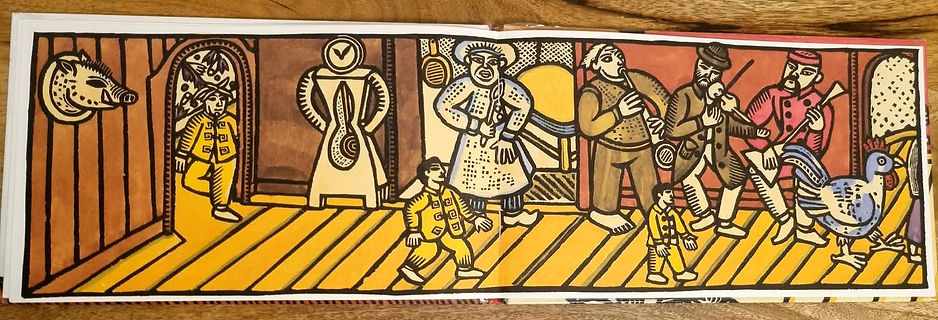
While their parents sleep, a group of children exits the house and find themselves in the world of imagination. All things are possible here: they drive a rabbit-chariot, meet gods and elephants, ride blue chickens and are invited to feast with the King.
The title translates to "The day of Kings", but the expression is also connected to the biblical "Twelfth night", the arrival of the three wise men. In France, this celebration is marked with a special cake, which can be seen at the fiest in the last spread.
Leclercq's artwork is really interesting. The illustrations are colored woodcuts, but the style is reminiscent of woven narrative tapestries, which Leclercq lists as one of his sources of inspiration.
Le jour des rois (2004) will delight both young and old readers, there is so much to dechiffer and so many possible storylines to explore.
Muzo
Un petit nuage & Dix petits nuages

Muzo is the pen name of Jean-Phillipe Masson, a French painter, children's book writer, illustrator, engraver, comic writer and artist. His contribution to the Histoire sans paroles-series is a delightful duology about clouds: Un petit nuage (One small cloud), published in 2004, and Dix petits nuages (Ten small clouds) published in 2008.
Both are drawn in a cute, naivistic illustration style. The idea is simple, but brilliant: In the first book, a small cloud emerges from a witch's cauldron and flies off to explore the world. Along the way, he has a lot of lovely encounters: a cute mouse, thirsty flowers, funny rabbits and more. In the end, he meets a girl cloud and falls in love.
The second book has the same illustration style and theme, and can be read as a sequel to the first. We have done a full review of the second book here (at the time, we did not know it was part of a duology...yes, we learn as we go along!)
Muzo uses bold, black outlines and bright colors. There is a lot of white space on each page, leaving ample room for the reader to "fill in the blanks", and imagine the surroundings as they please. This lovely duology would be great paired with La fabrique from the same series, that is also about clouds!


Béatrice Rodriguez
Le voleur de poule, La revanche du coq & Partie de pêche

Béatrize Rodriguez has a succesful career as a freelance illustrator. Her contribution to the Histories sans paroles-series is an important one: This is one of very few wordless triologies, and the first book in the series, Le voleur de poule (The chicken thief) was a big hit that has been republished several times. It has been published in many countries and is still in print.
The three books was published in 2005 (Le voleur de poule), 2011 (La revanche du coq) and 2013 (Partie de pêche)
All three books can be read as stand-alone titles, but reading them as a triology more than triples the fun. We have already made a full review of this triology, you can find it, and more pictures from the books, at this page.
If you are looking to buy these books, beware that all three have been published in one binding under the title Le voleur de poules et autres histories sans paroles by publisher Casterman, this will probably be the easiest way to aquire the whole triology.


Philippe Roux
Monsieur Vadelanvant

Monsieur Vadelavant (2004) is one of the first books that was published in a series. Our knowledge of French is limited, but our guess is that the protagonist's name is a play on the French expression "Aller de l'avant" - to move forward. Because that is exactly what this character is doing - with a happy, carefree smile he moves forward, crushing tents, cars, houses and causing general mayhem whereever he passes.
The only thing that can make him stop, is a beautiful woman... Suddenly, he is light as a feather and fly away. The secret to what made him so heavy is found inside his hat...
Using comic-style panels, silhouettes and bright, clear colors, Roux has made an amusing and very charming wordless adventure, filled with funny moments and details to explore.

Mandana Sadat
Mon lion
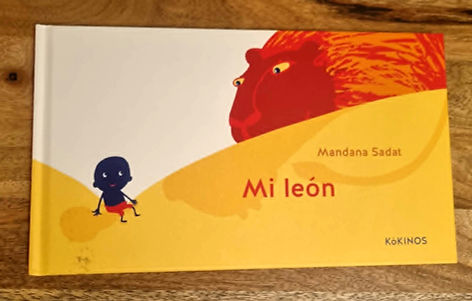
Mon lion (2005) is one of the books in this series that has the most translations to other languages: it is also published in Mexico, Brazil, Japan, Korea, China, Germany and Italy.
No wonder, because My lion (which the title translates to) really is a gem of a silent book. A lion and a boy become friends. They share both peaceful and very dramatic moments together, before we learn it was all a dream...or did it really happen, and they reunite in the dream world?
Sadat has a masterful use of the long, horizontal format. He uses it to make the reader understand the magnitude of the lion and how small the boy is in comparison. The illustrations portray movement, danger and feelings in a striking and masterful way.
Mandana Sadat is also the author of another internationally acknowledged silent book: De l'autre côté de l'arbre (not a part of this series, but a Readsilentbooks favourite)

Fernando Vilela
Le chemin

Le chemin starts with a visual burst of drama, and manages to take it uphill from there! A knight and his horse, powerfully portrayed with intense black and dramatic contrasts, rushes forward with his lance held high. He meets dangers on his ways - an angry dragon, a giant serpent, enemy fire, but lets nothing stop him on his path to rescuing the princess.
The knight and princess are then rescued by a giant bird who flies them over the beautiful city, off to a happily ever-after.
A must for all lovers of fairytales and adventures! Vilela's illustrations are stunning, and there is a wonderful rythm to the book, guiding the reader forward along with the knight.
The title, Le chemin (2007) translates to The path.
Fernando Vilela is one of the few non-French authors in this series, he is a Brazilian artist and illustrator known for mixing different artistic techniques.
