
Балконът
By: Kalina Muhova
Published: Tochitza, Bulgaria, 2018
Format: Hardcover

Dark and poetic
"There's a crack in everything, that's where the light comes in". Being unfamiliar with the orginal poem that inspired this book, it was the lines of Leonard Cohen that came to my mind when I read it. Балконът is a story about how walls stop us from seeing the light and experiencing the world, be it literal walls, or the walls we build with human, social or cultural bricks.
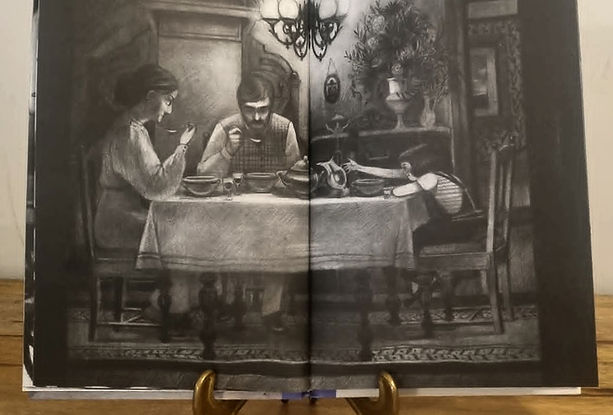
In a dark and gloomy city, Muhova brings the reader into a dark and gloomy house. A little girl is having supper with her parents. There is no love, warmth or smiles at this table, only a mother's stern glare and a father's disinterest. Our protagonist breaks a vase, is yelled at and then sent into another room. Doing a little mischief, the girl discovers a new source of light, a light that is reflected in her father's comfort and understanding. Together, they leave the gloomy house and goes outside, to a world that now seem a little brighter.
Балконът is the first Bulgarian silent book printed in this century. Illustrator and artist Kalina Muhova was offered this project from Tochitsa Publishing house, to be based on a poem of Bulgarian poet Atanas Dalchev. The scenario was written by Bulgarian author Zornitsa Hristova, and the story is set in the city of Sofia at the time when the poem was written, in the 1930s.
Muhovas illustrations are masterful, portraying both the darkness and the light with beauty and sensitivity. The reader can feel the silence of this unhappy house, the stuffiness of the air, the repression of feelings - making the relief even greater when the light finally is able to enter. The illustrations also offers details that gives food for thought and room for interpretation, like the couple of lovely birds living in the tree next to our protagonists house. They are introduced in the first pages of the book. In the last pages, the birds have gone, and there is a black cat in the tree instead...
Even though the visual surroundings, like houses, clothing and objects like telephones, have an old-fashioned, nostalgic feel, the symbolism and feelings the illustrations invoke in the reader are universal: Of hope, of a need for a broader outlook on the world, of how new perspectives can shift both moods and relationships.

